
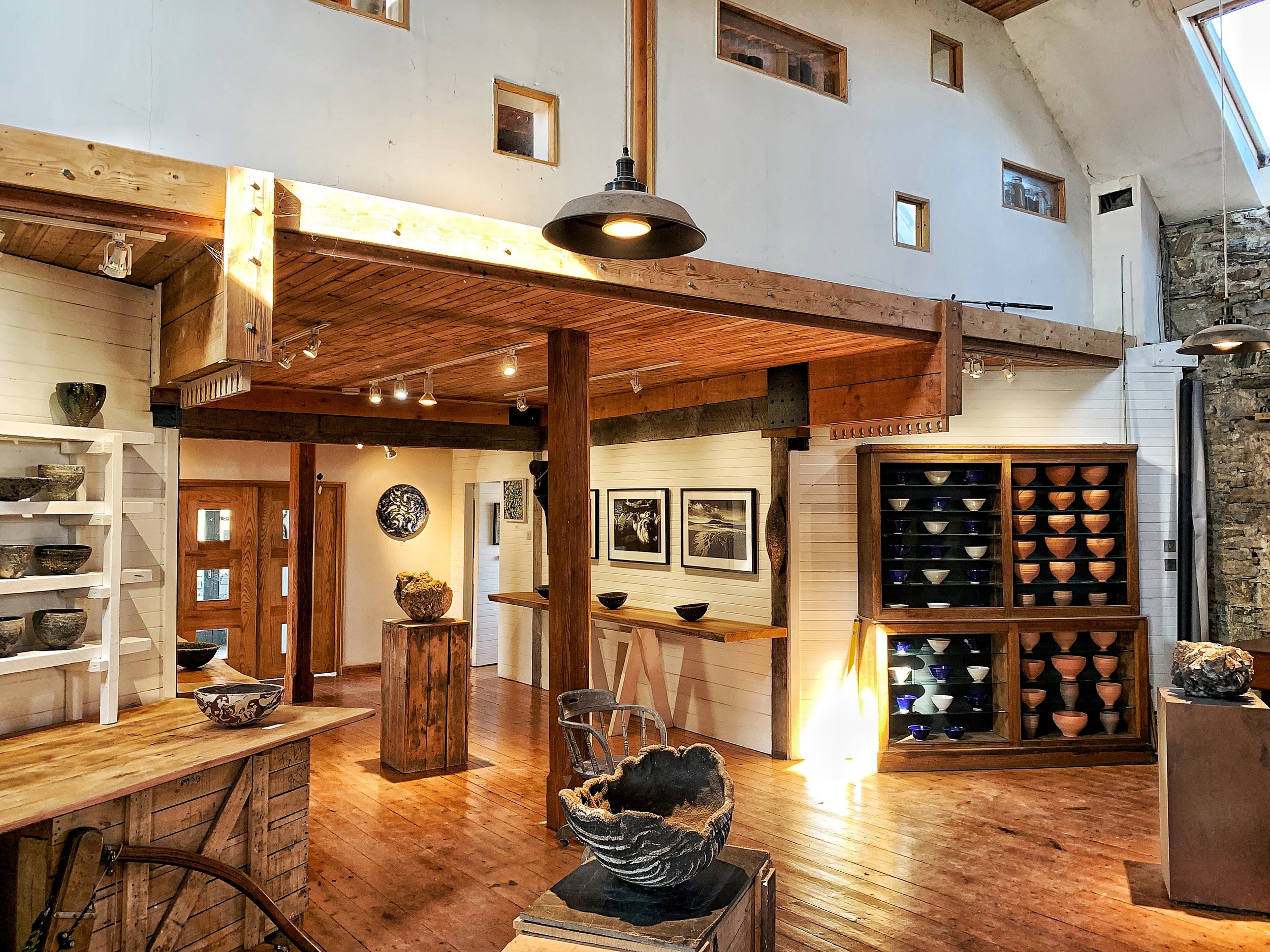
The Mission House Studio, Finsbay, Isle of Harris, HS3 3JD. Tel: 01859 530 227
We are now Open 10am to 6pm | Monday to Saturday

Email

Directions

Links

Photography


Beka Globe
Photography

Beka Globe came to Harris when she was just 11 years old. Her father, sculptor Steve Dilworth stills lives and works locally. She studied photography and darkroom techniques from an early age at Napier University in Edinburgh. There she was inspired by Ansel Adams' landscapes, Paul Strand's portaits and Hiroshi Sugimoto's seascapes.

Having travelled extensively, photographing America and New Zealand she returned to the Hebrides to explore her roots in the landscape she first viewed through the lens. Here she captures an emotive vastness, depth and simplicity. Her silent images are deeply moving, stirring a particular sense of place.

In her new collection for 2011 Beka explores The Edge, where the land meets the sea, the sea meets the sky, and the sky meets the land. A dynamic place where elements collide, interact and influence one another. Photographed during the winter these extremes of environment explode with energy and Beka's images hold those timeless and elemental forces of nature.

New work of Beka's Photographs online soon. Extensive back catalogue online now.

Click here

Ceramics


Nickolai Globe
Ceramics

Nickolai was born into clay. Now he has fused himself to Harris, where the influence of his ironage nordic bogman ancestors have fluxed his Wabisabi pre-occupation to create his archaic works. High fired earthenware, stoneware and local minerals is his palette, the terrain of the Harris his muse.

His new work takes ceramics to the edge of craft, where sculpture and function merge. His high fired stoneware bowls and vessel forms become more geological and carry with them a deep reflection of the terrain of the Hebrides. Incorporating glass and raw minerals into his work they literally embody the landscape.

Wabisabi:

An aesthetic centered on the acceptance of transience, described as one of beauty that is imperfect, impermanent, and incomplete. If an object or expression can bring about, within us, a sense of serene melancholy and a spiritual longing, then that object could be said to be wabi-sabi.

Referring to the loneliness of living in nature, remote from society it connotes rustic simplicity, freshness or quietness, and can be applied to both natural and human-made objects. It can also refer to quirks and anomalies arising from the process of construction, which add uniqueness and elegance to the object.

Wabisabi suggests sentiments of desolation and solitude.

New work of Nickolai's Ceramics online soon. Extensive back catalogue online now. Click here

Music


Friday 22nd June 2012 - 7pm


The Six Suites for Unaccompanied Cello by Johann Sebastian Bach are some of the most performed and recognizable solo compositions ever written for cello. They were most likely composed during the period 1717– 1723, when Bach served as a Kapellmeister in Cöthen.

The suites contain a great variety of technical devices, a wide emotional range, and some of Bach’s most compelling voice interactions and conversations. It is their intimacy, however, that has made the suites amongst Bach’s most popular works today.

Performance

Suite No. 1 in G major, BWV 1007

    The Prelude, mainly consisting of arpeggiated chords, is probably the best known movement from the entire set of suites and is regularly heard on television and in films.

Suite No. 2 in D minor, BWV 1008

    The Prelude consists of two parts, the first of which has a strong recurring theme that is immediately introduced in the beginning. The second part is a scale-based cadenza movement that leads to the final, powerful chords. The subsequent Allemande contains short cadenzas that stray away from this otherwise very strict dance form. The first Minuet contains demanding chord shiftings and string crossings.

Suite No. 3 in C major, BWV 1009

    The Prelude of this suite consists of an A-B-A-C form, with A being a scale-based movement that eventually dissolves into an energetic arpeggio part; and B, where the cellist is introduced to thumb position, which is needed to reach the demanding chords. It then returns to the scale theme, and ends with a powerful and surprising chord movement.The Allemande is the only movement in the suites that has an upbeat consisting of three semiquavers instead of just one, which is the standard form. The second Bourrée, though in C minor, has a 2-flat (or G minor) key-signature. This rotation, common in pre-Classical music, is sometimes known as a partial key-signature.


Download the Programme

Book Online Now
Limited Seats!

Friday 22nd June 2012

7:00pm

£18.00 Per Ticket